The Temple of Khnum at Esna
The Temple of Khnum at Esna
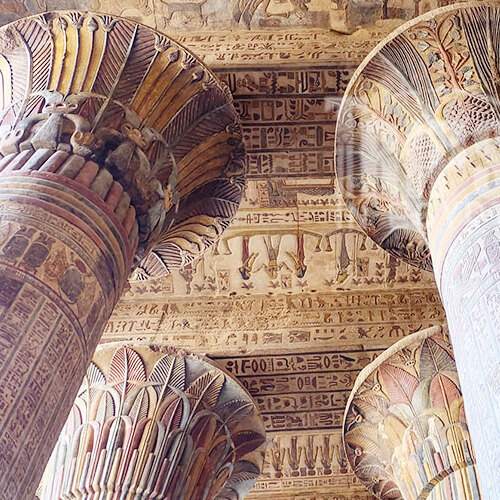
Between Luxor and Edfu, the Nile cruise route passes through a town that most motor vessels stop at only briefly, and that many skip entirely. Esna — ancient Latopolis, 55km south of Luxor on the west bank — contains one of the most remarkable Ptolemaic-Roman temples in Egypt. The Temple of Khnum is not remarkable for its scale: only its hypostyle hall survives above ground, the rest of the original structure buried beneath the modern town. What survives is extraordinary. Twenty-four sandstone columns with intricately carved and painted capitals, an astronomical ceiling of extraordinary complexity, inscriptions recording 90 days of annual festivals, and — following a decade of ongoing restoration by Egyptian and international conservators — original colours that were invisible under centuries of soot and grime now vivid again for the first time in over a thousand years.
The temple sits in a 9-metre-deep pit, which represents fifteen centuries of accumulated desert sand, debris, and the foundations of successive towns built directly over it. The depth of the pit is itself a striking first impression: you descend into antiquity before you enter the building. Most of the original temple complex — which was similar in scale to the temples of Edfu and Dendera — remains buried under the streets of modern Esna, and will likely remain so permanently.
The God and the Place
Khnum is one of Egypt’s oldest deities, worshipped since the Early Dynastic period. He is depicted with the head of a ram — the animal associated with fertility and creative power in the Upper Egyptian religious landscape — and understood as the god who fashions all living things on a potter’s wheel from Nile clay, shaping not only the body but the ka (the life-force or spiritual double) of every creature at the moment of creation. His association with the Nile’s source, with the inundation’s fertility, and with the creative act itself made him one of the most theologically fundamental deities in Upper Egypt.
At Esna he was venerated in a specific composite form: Khnum-Ra, fusing the creator god with the sun god Ra to produce a deity who encompassed both cosmic generation and solar power. His consorts at Esna were Menhit (a lion-headed warrior goddess) and Nebtu (goddess of the oasis); their son Heka personified magic and was understood as the divine energy that animated Khnum’s creative act. The goddess Neith — ancient goddess of war and weaving, one of the oldest in the Egyptian pantheon — was also venerated here. This is not a simple single-deity temple; it is a cult centre for a specific divine family whose theology was elaborated in the temple’s inscriptions in exceptional detail.
The ancient Egyptian name for the town was Iunyt or Ta-senet. The Greeks called it Latopolis — City of the Fish — after the Nile perch (Lates niloticus) that was held sacred here, abundant in this stretch of the river and associated with Neith. The fish was buried in a dedicated cemetery west of the town.
Construction and History
A first shrine or temple at this site was established during the reign of Thutmose III in the 18th Dynasty, making the sacred site here approximately 3,500 years old. However, only reused blocks from this early phase survive. The visible temple is almost entirely Ptolemaic and Roman in date, built over several centuries of construction and decoration.
The oldest surviving element is the back wall of the hypostyle hall, constructed during the Ptolemaic period and featuring reliefs of Ptolemy VI Philometor and Ptolemy VIII Euergetes. The rest of the excavated hall was built and decorated by a succession of Roman emperors — from Claudius (41–54 AD) through to Decius (249–251 AD) — who presented themselves in full pharaonic iconography on the columns and walls, following the long-established convention of Roman emperors in Egypt adopting Egyptian divine kingship as a mechanism of legitimacy.
The last known hieroglyphic inscription ever carved is found at the foot of a relief on the temple’s western wall, completed under the Emperor Decius in approximately 250 AD. After that date, the tradition of carving in hieroglyphic script ceased. Esna’s temple thus carries not only the earliest evidence of Thutmoside worship on this site but also the final datable use of the script that had defined Egyptian sacred writing for over three thousand years.
By the 7th century AD the temple had been abandoned. Sand and debris accumulated over it until the hypostyle hall, buried to its roof, was excavated and cleared in the 19th century — whereupon it was pressed into service as a cotton warehouse by the Egyptian government. The carbon deposits from that period, combined with centuries of accumulated grime, had blackened the reliefs and obscured the original painted decoration almost completely.
The Hypostyle Hall: What Survives
The surviving structure is the pronaos — the entrance vestibule of the original temple — which is what visitors walk through today. It is not a fragment. It is a fully roofed hall of 24 columns arranged in six rows of four, the columns supporting an intact ceiling that is one of the most complex astronomical programmes in any surviving Egyptian temple.
The columns themselves are worth extended attention before looking up. Each capital is different — carved in the form of palm leaves, lotus buds, papyrus fans, and bunches of grapes (the grape capitals are distinctively Roman, introduced in the later phases of decoration). The lower sections of the columns carry long hieroglyphic texts describing religious festivals and rituals, including hymns to Khnum; the middle sections carry reliefs of Roman emperors in pharaonic costume making offerings to the Esna deities. One column depicts the Emperor Trajan dancing before the goddess Menhit — a scene that combines Roman imperial power, Egyptian ritual form, and entirely local theology into a single carved image.
The western facade carries a notable scene: Khnum and Horus together dragging a net full of fish from the Nile. It is an image of the local sacred economy — the fish of Latopolis, the river, the gods — and it frames the entrance to the hall in a way that makes the temple’s relationship to this specific place explicit.
The Astronomical Ceiling
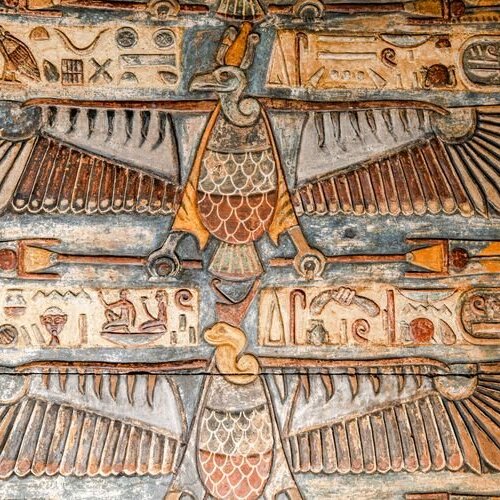
The ceiling of the hypostyle hall is its most celebrated feature and the primary focus of the ongoing restoration programme. It is divided into bands and bays, each carrying a distinct astronomical theme, creating a total sky map of extraordinary ambition.
The programme includes: the full zodiac — all 12 signs from Aries to Pisces, the only complete zodiac in this form in the Nile Valley outside Dendera; 36 decan figures (the star groups used by ancient Egyptians to measure the 12 hours of the night); moon deities standing atop discs whose waxing and waning phases reflect the lunar cycle; the planets Jupiter, Saturn, and Mars; the constellations Orion’s Belt and the Dog Star (Sirius); and the goddess Nut arching across the central axis, her body encompassing the sky.
Among the more unusual elements are depictions of the Seven Arrows — messengers of Sekhmet, the goddess of disease — which are rarely represented in temple decoration. Conservators have recently revealed their names in inscriptions that were invisible before the cleaning work, including one designated “who steals the heart, who loves one.” The precise astronomical significance of the Arrows in the Esna programme remains a subject of active scholarship.
The ceiling also carries a unique cosmological text — a hymn of creation — that describes Khnum as the creator of all living things, including foreigners and animals, in a theological universalism unusual in Egyptian religious texts of this period.
The Restoration
Between 2018 and the present, a team of Egyptian conservators led by Ahmed Emam, working under the auspices of the American Research Center in Egypt (ARCE) and the Egyptian Ministry of Tourism and Antiquities, has been systematically cleaning and restoring the temple’s decorated surfaces. The results have been dramatic.
The original colours — vivid blues, reds, and yellows on the ceiling figures; precise black and ochre detailing on the column inscriptions — had been invisible for centuries under layers of soot from the cotton warehouse era and accumulated grime. As the cleaning has progressed bay by bay, the temple has been transformed from a building of darkened, barely legible surfaces into one of the most colourfully intact interiors in Upper Egypt.
The restoration is ongoing. Visitors today see the hall in a state of partial transformation — some sections fully cleaned and brilliantly coloured, others still dark — which creates an unusual before-and-after effect within a single space. This is not a limitation; it is an opportunity to see conservation work in its context, and to understand concretely what cleaning reveals.
The Quay of Marcus Aurelius
Outside the temple, connecting it to the Nile, is a stone quay built under the Roman Emperor Marcus Aurelius (161–180 AD). The quay bears his cartouches. It is a useful reminder that the temple’s Roman-period decoration was not merely decorative opportunism but part of a functioning imperial investment in the site — emperors built quays, funded construction, and presented themselves in pharaonic form here as a matter of deliberate religious and political policy spanning several centuries.
The quay is largely buried and not prominently visible, but its existence is worth knowing: the ceremonial route from the Nile to the temple entrance, lined by the quay Marcus Aurelius commissioned, is the same path that visitors walk today.
Practical Information
Location
The Temple of Khnum stands in the heart of modern Esna, on the west bank of the Nile, approximately 55 km south of Luxor and around 150 km north of Aswan. Unlike many Egyptian temples set apart in desert landscapes, this remarkable structure lies directly within the town’s central square.
Visitors arriving by Nile cruise dock at the Esna embankment and walk through the town’s lively covered market street, which runs directly from the river quay to the temple entrance. The walk takes roughly 10 minutes and passes through a traditional bazaar atmosphere filled with textile stalls, tailors, and local merchants.
Getting There
Many Nile cruise itineraries traveling between Luxor and Aswan include a stop at Esna, although some schedules bypass it. Travelers who consider Esna a priority should confirm the stop before booking their cruise.
Esna is also easily accessible by road from Luxor, with the journey taking about 45 minutes by car. It can be combined with visits to Edfu Temple and Kom Ombo Temple for a rewarding full-day exploration of Upper Egypt’s temple corridor.
Suggested Experience: Luxor to Esna, Edfu & Kom Ombo Full-Day Private Tour
Opening Hours
The temple is generally open daily from 07:00 AM to 04:00 PM. On certain days, extended evening visiting hours may be available. Opening times may also vary seasonally or during the month of Ramadan, so checking locally upon arrival is recommended.
Time Needed
Allow approximately 45 minutes to one hour to explore the temple’s hypostyle hall at a comfortable pace. Visitors often choose to spend additional time strolling through the covered market arcade on the walk back toward the Nile corniche.
This charming bazaar is one of Upper Egypt’s most atmospheric market streets, featuring traditional tailors, fabric merchants, and small workshops housed within a 19th-century vaulted arcade.
Guide Value
A knowledgeable guide significantly enhances the experience. The temple’s columns contain detailed inscriptions, while the ceiling displays an elaborate astronomical program and religious calendar texts that benefit from expert interpretation.
Guides can also explain the remarkable modern restoration project that revealed the temple’s vivid original pigments, pointing out where ancient colours have been carefully cleaned and preserved.
Recommended: Private guided exploration of Esna Temple
Practical Notes
- Cash only: No ATM is located immediately beside the temple.
- Footwear: Wear comfortable shoes; visitors descend roughly 9 metres below street level to reach the temple floor.
- Photography: Photography is permitted throughout the site. Flash restrictions are not currently enforced but may change.
Why Esna Temple Matters
Esna rarely appears at the top of most travelers’ Upper Egypt itineraries. Famous temples such as Karnak, Luxor, Edfu, and Abu Simbel usually dominate the list. Because only one major structure of the Esna complex survives—the great hypostyle hall—many visitors treat it as a brief stop rather than a destination.
That perception overlooks its exceptional significance. The Temple of Khnum preserves some of the best surviving Ptolemaic-Roman temple decoration in Egypt, including ceilings still displaying their original colours.
Even more remarkable, Esna contains the last known hieroglyphic inscription ever carved, marking the final chapter of a writing tradition that endured for more than three millennia.
Thanks to ongoing restoration work, visitors today witness something unseen for over a thousand years: the temple’s vivid painted reliefs emerging from centuries of soot and dust, revealing how the building truly appeared when it was still an active sanctuary.
Created On March 10, 2014
Updated On July 22 , 2025