Only In Taba
Only Here Taba
Taba sits in Egypt’s northeastern corner where the Sinai mountains descend to the Gulf of Aqaba, occupying one of the most geographically unusual positions in the country: a short stretch of coastline where Egypt, Israel, Jordan, and Saudi Arabia converge. It is a quieter destination than Sharm el-Sheikh or Dahab, but there is more to do here than the resort hotels suggest.
Pharaoh’s Island and Saladin’s Citadel
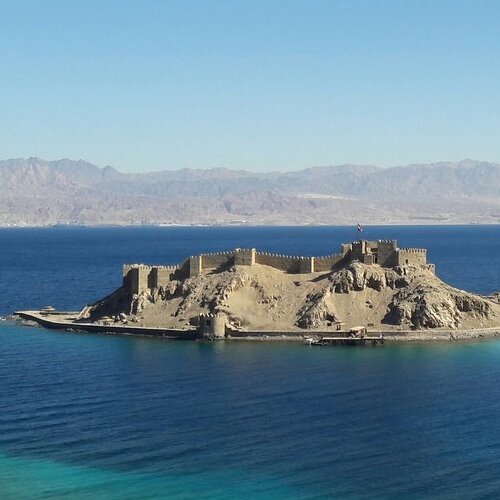
About 8 kilometres south of Taba, a small granite island rises 250 metres offshore. The island holds a medieval fortress — officially Saladin’s Castle — built at a crossroads of trade and pilgrimage routes between Egypt, the Arabian Peninsula, and the Crusader kingdoms of Palestine. The Crusaders established a fortress here in the early 12th century to control passage through the Gulf of Aqaba and levy tolls on Muslim pilgrims travelling to Mecca. Saladin seized it in 1171 and substantially expanded and refortified it. The complex includes soldiers’ quarters, a mosque, a hammam, grain stores, cisterns carved into the rock, a pigeon tower used for communications, and a workshop for producing arrowheads — a complete medieval military installation. The island was added to UNESCO’s World Heritage Tentative List in 2003.
Access is by short boat trip from the shore. Advance booking is advisable; entrance to the fortress requires a ticket, and visitors who arrive without one may be restricted to viewing from the water.
Fjord Bay
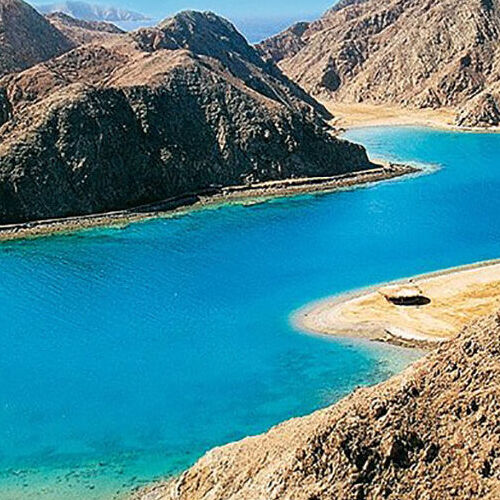
A short drive south of Taba brings you to Fjord Bay, a deep natural inlet where desert cliffs drop to clear water. It is a recognised shark nursery and a good snorkelling and diving spot. Less visited than the reefs of the Taba Heights hotels, it offers better access to undisturbed marine life for those willing to make the trip independently. Dive centres in Taba Heights can organise excursions.
The Four-Country View
From Taba Heights and from the top of Pharaoh’s Island, you can look out across the Gulf of Aqaba and see the coastlines of Egypt, Israel, Jordan, and Saudi Arabia simultaneously. It is a genuinely unusual vantage point — four countries visible from a single spot.
Desert Hiking and Canyons
The desert landscape surrounding Taba is part of the Taba Protected Area, a network of wadis, granite mountains, and sandstone canyons. Wadi Watir — a narrow gorge running down to the Gulf near Nuweiba — is the most accessible entry point into this landscape, and the Coloured Canyon, about 90 minutes from Taba by road, is the area’s most visited geological formation: twisting sandstone corridors stained in layered shades of red, purple, and gold. Tours can be arranged through hotel activity desks, and a Bedouin guide is recommended for the more remote wadis. Bring far more water than you think you need regardless of season.
Birdwatching
During spring (March to May) and autumn (September to November), Taba lies on the migration corridor between Africa and Eurasia. Raptors, storks, and smaller migrant species pass through in significant numbers, and the combination of Gulf of Aqaba coastline and desert interior makes the area genuinely productive for birdwatchers. No specialist infrastructure exists for this — it is simply an incidental benefit of the location.
Day Trips
Taba works well as a base for excursions. Saint Catherine’s Monastery is around three hours by road; most tours combine it with a pre-dawn hike to the summit of Mount Sinai to catch sunrise. Petra in Jordan is a long but achievable day trip via the Aqaba crossing. The Coloured Canyon is the most popular half-day option and can be combined with a visit to Pharaoh’s Island. A day trip to Eilat across the Israeli border is straightforward for those whose visa situation allows it — see Getting Around Taba for re-entry caveats.
Created On March 18, 2020
Updated: March 2026