Mosque of Sayyidna al-Hussein
Mosque of Sayyidna al-Hussein: Where Sacred History Unfolds
In the heart of Egypt, where the tapestry of Islamic heritage is intricately woven, stands a sanctuary of profound significance – the Mosque of Sayyidna al-Hussein. Among the hallowed grounds of this mosque lies a legacy that transcends time, for it is believed to enshrine the final resting place of Hussein, the revered grandson of the Holy Prophet.
Hussein’s poignant journey culminated in Karbala, Iraq, where he met his heroic end. His sacrifice is said to have brought reconciliation between the Shia and Sunni branches of Islam, healing a schism that had endured through the ages.
While claims persist that a similar Shiite artifact resides in Damascus’ Umayyad Mosque, and both mosques were founded by Sunni adherents, the significance of the Mosque of Sayyidna al-Hussein remains unrivaled. Its sacred precincts remain closed to non-Muslims, shrouded in an aura of exclusivity that only deepens its mystique.
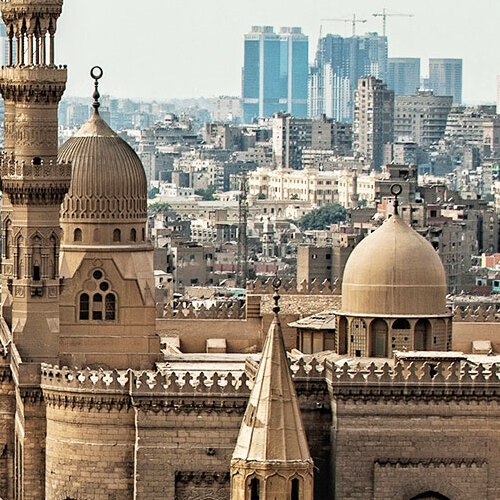
As you step into this sacred space, you’ll be greeted by the soaring minaret adorned with exquisite stucco panels, a testament to the architectural craftsmanship of the 14th century. However, most of the surrounding structures trace their origins to the 1870s, offering a blend of historical resonance and contemporary allure.
Modernity meets tradition in the form of captivating metal sculptures that dot the landscape. These artistic expressions add a dynamic dimension to the mosque’s ambiance, inviting contemplation and reflection. Large canopies gracefully extend their shelter, providing solace to the faithful who gather here for Friday prayers, a harmonious convergence of devotion and architectural splendor.
The Mosque of Sayyidna al-Hussein stands as a living testament to Egypt’s rich Islamic heritage, where sacred history unfolds in all its profound glory. It is a place where the faithful come to seek solace and inspiration, and where the timeless legacy of Hussein continues to unite hearts in reverence and devotion.
Created On May 4, 2020
Updated On July 22 , 2025
- Al-Azhar Mosque
- Al-Azhar To The Citadel
- Amir Taz Palace
- Aqsunur’s Mosque
- Bab Zuweila
- Beit Al-Harrawi
- Beit Al-Suhaymi (Al-Suhaymi House)
- Beit Zeinab al-Khatoun
- Bein al-Qasreen STREET (Between The Two Palaces {Street})
- Ben Ezra Synagogue
- Church of St. Barbara
- Coptic Cairo
- Egyptian Textile Museum
- Gawhara Terrace
- Gayer-Anderson Museum
- Ibn Tulun Citadel
- Khan Al-Khalili Bazaar (Cairo’s Most Famous Bazaar)
- Khanqah & Mausoleum of Sultan Baybars al-Gashankir
- Khanqah-Mausoleum of Farag Ibn Barquq
- Madrassa & Mausoleum of as-Salih Ayyub
- Madrassa & Mausoleum of Qalawun
- An-Nasir Mohammed Bin Qalawoon Mosque
- Madrassa And Mausoleum of Barquq
- Mausoleum of Al-Ghouri
- Midan Al-Hussein (Sayedna Al-Hussein Square)
- Mosque of Al-Hakim
- Mosque of Al-Mu’ayyad Shaykh
- Mosque of al-Aqmar
- Mosque of Amr ibn al-As
- Mosque of An-Nasir Mohammed
- Mosque of Aslam al-Silahdar
- Mosque of Ibn Tulun
- Mosque of Mohammed Ali
- Mosque of Sayyidna al-Hussein
- Mosque-Madrassa of Al-Ghouri
- Mosque-Madrassa of Sultan Hassan
- Mosque-Madrassa of Umm Sultan Sha’aban
- Museo Mevlevi
- Museum of Islamic Art
- Northern Cemetery
- Northern Enclosure
- Northern Walls and Gates
- Sabil And Kuttab Of Abdel Rahman Katkhuda
- Sabil of Muhammed Ali Pasha
- Sharia al-Muizz li-Din Allah
- The Church of St Sergius & Bacchus
- The Citadel Of Saladin
- The Complex of Sultan Ashraf Barsbey
- The Coptic Museum (The Only Coptic Museum In Egypt)
- The Egyptian Museum
- The Hanging Church
- The Khayrbek Complex
- The Mosque of Sultan Qaitbey
- The Roman Towers
- Wikala al-Bazara
- Wikala of Al-Ghouri